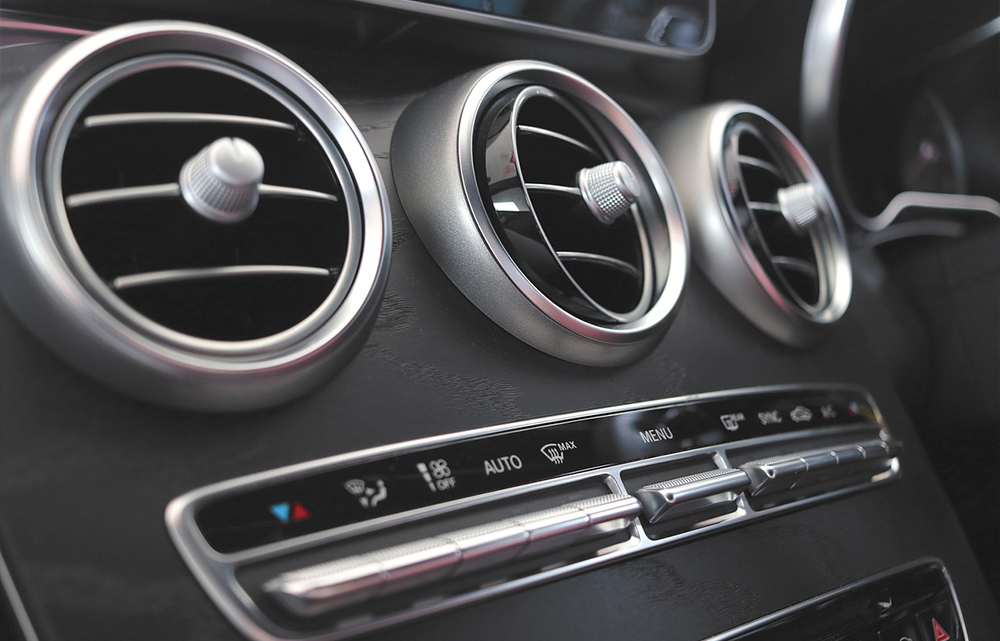
Modern automotive air conditioning systems consist of a refrigeration system, a heating system, ventilation and air purification devices, and a control system.
1. Ventilation System: Its function is to ensure in-car ventilation while the vehicle is moving, that is, to continuously supply fresh air into the passenger compartment and expel air mixed with dust, carbon dioxide, and harmful gases from the engine. In cold winter, the fresh air is also heated to maintain a suitable interior temperature.
2. Heating System: It heats the air inside the passenger compartment or the fresh air entering from outside, achieving the goals of warming and dehumidification.
3. Refrigeration System: It lowers the in-car temperature when the external ambient temperature is high, providing passengers with a cool and comfortable environment.
4. Air Purification System: It filters the incoming air and continuously removes stale gases from the passenger compartment to keep the in-car air clean.
5. Control System: Composed mainly of electrical components, vacuum lines, and operating mechanisms, the control system regulates the temperature and pressure of the refrigeration and heating systems on one hand, and controls the temperature, air volume, and airflow direction inside the car on the other, to perfect all functions of the air conditioning system.
A typical automotive air conditioner consists of a compressor, an electronically controlled clutch, a condenser, an evaporator, an expansion valve, a receiver drier, hoses, a condenser fan, a vacuum solenoid, an idle speed controller, and a control system. Automotive AC systems are divided into high-pressure and low-pressure circuits. The high-pressure side includes the compressor outlet, high-pressure lines, condenser, receiver drier, and liquid lines; the low-pressure side includes the evaporator, accumulator, return lines, compressor inlet, and compressor oil sump.
Receiver Drier: In essence, it is a device that stores refrigerant and absorbs moisture and impurities from the refrigerant. On one hand, it acts like a vehicle fuel tank, replenishing refrigerant to compensate for leaks. On the other hand, similar to an air filter, it filters out contaminants mixed in the refrigerant. It also contains a certain amount of silica gel to absorb moisture.
Condenser and Evaporator: Although named differently, they have similar structures. Both are heat exchange devices fitted with metal cooling fins around a series of coiled tubes to transfer heat between the outside air and the medium inside the tubes. Condensation in the condenser refers to the refrigerant inside the tubes releasing heat and changing from gas to liquid. Its principle is similar to that of an engine coolant radiator (except that the water in the radiator remains liquid), so it is usually mounted at the front of the vehicle alongside the radiator to benefit from incoming airflow. In short, the condenser is positioned in a cool area to facilitate heat dissipation and condensation. In contrast, the evaporator is where the refrigerant absorbs heat by changing from liquid to gas (i.e., evaporation).