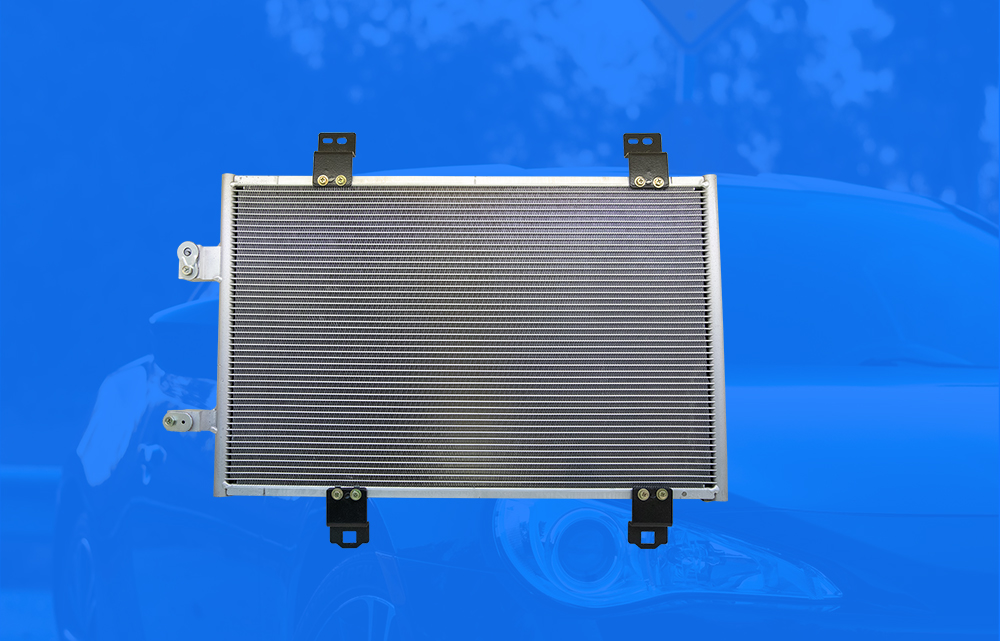
The function of the automobile air conditioning condenser is to cool the high temperature and high pressure refrigerant vapor discharged by the compressor and condense it into liquid high pressure refrigerant.
It can cool and liquefy the high pressure and high temperature refrigerant (gaseous refrigerant) sent from the compressor. The following is an introduction to the working principle of automobile air conditioning condenser:
1. When the refrigerant enters the evaporator, the pressure decreases and changes from high pressure gas to low pressure gas. This process needs to absorb heat, so the surface temperature of the evaporator is very low, and then the cold air can be blown out through the fan. The cold condenser is to cool the high pressure and high temperature refrigerant from the compressor into high pressure and low temperature. Then it is vaporized through capillary tube and evaporated in evaporator.
2. The condensers and evaporators in automobile air conditioners are collectively referred to as heat exchangers. The performance of heat exchanger directly affects the refrigeration performance of automobile air conditioner. Its metal material consumption is large, its volume is large, and its mass accounts for 50%~70% of the total mass of the entire automobile air conditioning device. The space it occupies directly affects the effective volume of the vehicle, and it is difficult to arrange, so it is extremely important to use efficient heat exchanger. The condenser and evaporator in the automobile air conditioning device should be matched with the compressor and also with the throttling expansion mechanism. The working state of the condenser and evaporator directly affects the capacity of the refrigeration system (refrigerating capacity), the power consumption of the compressor and the economy of the entire air-conditioning unit.